Before you buy a single plant, pace out your plot. Walk the length and width, count your steps, then write the rough measurements down. Do the same at three points in the day: morning, early afternoon and early evening. Note where the sun lands and where shadow sits. That ten-minute exercise changes everything. A courtyard that bakes from noon is a different design problem from a balcony that only sees two hours of light. Once you know the real dimensions and the real light, every cheap decision after that gets easier, because you stop guessing and start choosing.
Small garden design ideas on a budget work best when you treat the space like a room rather than a leftover patch of ground. That means measuring, zoning, and deciding what the eye should land on first. You do not need a landscaper or a big spend. You need a plan and a willingness to swap expensive materials for clever ones.
Measure, Zone and Decide What the Space Is For
Most tiny gardens fail because they try to do everything. There is a potted herb corner, a bench, a washing line, a bike store and a barbecue all fighting for the same two square metres. Pick two jobs for the space and let the rest go. A courtyard might be a place to sit with a coffee and a place to grow cut flowers. A balcony might be a place to eat and a place to dry laundry, with the laundry hidden behind a screen.
Sketch the plot on graph paper, one square per 30cm. Mark the doors, the drain, the tap, the manhole cover and the direction of the sun. Now draw the zones. Sitting zone. Growing zone. Storage zone. Circulation, the path you actually walk, is the one people forget, and it is the reason a garden feels cramped. If you have to sidestep a pot every time you go out, the layout is wrong, not the size.
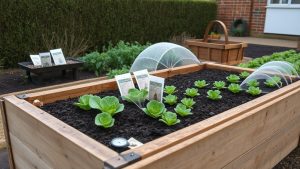
Renters should check the tenancy before digging. If the ground is not yours to break, build everything above it: containers, raised troughs, freestanding trellis and clip-together deck tiles that lift when you leave. This is not a compromise. It is often the smarter design, because you can rearrange it as the seasons change.
Work out your budget honestly. A realistic split for a small plot is roughly half on structure, a third on plants and the rest on lighting and finishing touches. Structure is the bones: screening, a surface to stand on, somewhere to sit. Buy the bones first. Plants are cheap to replace and easy to add later, but a wobbly path or a bare fence line will bother you all year.
Borrow Space With Verticals Instead of Buying More Ground
You cannot buy more ground in a small garden, but you can borrow the air above it. Vertical growing is the single biggest trick in the small-space book, and it is almost always cheaper than extending the footprint.
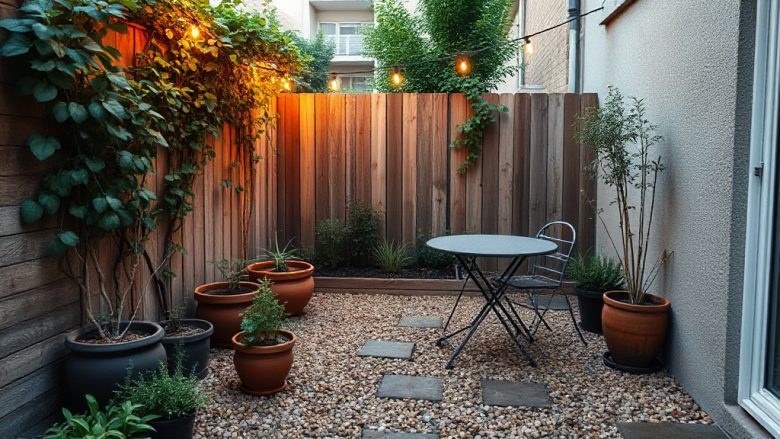
Fix trellis to a wall or fence and train climbers up it. For a north-facing wall, try ivy or a climbing hydrangea. For sun, jasmine, honeysuckle or a clematis will earn their keep. A single climber covering two metres of fence does more for the feel of a courtyard than six pots on the ground, because it pulls the eye upward and makes the boundary disappear.
Wall-mounted troughs and stacked planters add height without eating floor space. A cheap wooden pallet, sanded and painted, can become a tiered planter in an afternoon. Old guttering fixed to a fence makes a fine strawberry or salad run. Even a simple shelf at chest height turns a blank wall into a growing surface.
Mirrors are the classic small-garden cheat, and they still work. A weatherproof mirror hung on a boundary wall reflects light and greenery and makes a narrow courtyard feel twice its depth. Place it where it reflects something worth seeing, not a bin. A mirror facing a planted corner is worth more than any ornament you could buy.
Do not forget the overhead plane. A pergola or a simple frame with climbing plants softens the view upward and gives a sense of enclosure. If you rent, a freestanding arch or a pair of tall obelisks does the same job and moves with you.
Choose Cheap Hard Landscaping That Still Looks Designed
Hard landscaping is where small budgets get eaten. Paving is expensive, and in a tiny garden you need very little of it. The trick is to use less hard surface than you think and let planting soften the edges.
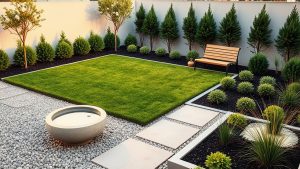
Gravel is the cheapest credible surface. A 20mm gravel over a weed-suppressing membrane costs a fraction of paving and drains well. Choose a single colour and keep it consistent, because mixed gravel looks like a builder’s yard. If you want a firm spot for a table, set a few large pavers into the gravel rather than paving the whole area. This gives you the look of a designed space for a fraction of the cost.
Bark chip is even cheaper and works well around beds, though it needs topping up. For a sitting area, clip-together deck tiles in a wood-effect finish are a renter-friendly option that lifts cleanly when you move out. Avoid busy patterns. In a small plot, one material used consistently reads as intentional, while three materials read as clutter.
Edging matters more than people expect. A crisp edge between gravel and soil makes a cheap garden look cared for. You can make one from timber offcuts, brick set on edge, or even a shallow trench cut with a spade. It costs almost nothing and does more visual work than a fancy ornament.
Reuse where you can. Old bricks, broken slabs and leftover timber from a skip can become a path, a step or a raised bed. Check that any timber you use is untreated or suitably preserved, and avoid anything that has held chemicals. Freecycle-style local swaps and builder’s surplus yards are good hunting grounds if you are willing to be patient.
Plant for Impact, Not Quantity
A small garden does not need many plants. It needs the right ones, repeated. Repetition is what makes a planting scheme look designed rather than accidental. Buy three of the same grass, five of the same perennial, and place them in a loose drift. The eye reads it as a decision.
Go for foliage first. Leaves last longer than flowers and give structure through the year. A single large-leaved plant, such as a fatsia or a hardy palm in a pot, anchors a corner and adds instant maturity. Grasses add movement and catch the light, which matters in a space that can feel static.
Choose long-flowering, low-maintenance plants. Salvias, hardy geraniums, verbena and rudbeckia flower for months and cope with neglect. Herbs earn double duty: rosemary, thyme and sage look good, smell good and end up in the kitchen. If you have shade, ferns, hellebores and epimedium will fill it without fuss.
Buy small. Plug plants and 9cm pots are far cheaper than mature specimens, and in a small garden they catch up within a season. Grow annuals from seed for cheap colour, and let a few self-seeders such as nigella or calendula wander through the gravel. That looseness is what stops a tiny plot looking rigid.
Group pots rather than scattering them. One large pot with a bold plant beats five small ones with sad odds and ends. Terracotta is cheap and ages well. If you need lightweight containers for a balcony, look for fibre-clay or grow bags disguised with a woven cover. Always check the weight limit before filling a balcony with compost, which is heavier than it looks when wet.
Finish With Lighting and Containers That Stretch the Evening
Lighting is the cheapest way to make a small garden feel expensive after dark. It also extends the hours you can actually use the space, which matters more in a small plot than a large one.
Skip the floodlights. Layer low-level light instead. Solar stake lights along a path cost very little and need no wiring. A string of warm-white festoon lights across a pergola or between two posts creates a ceiling of light and makes a courtyard feel like a room. Uplight one plant or one wall with a single rechargeable lamp and you have instant drama for the price of a takeaway.
Keep the colour temperature warm, around 2700K, and avoid bright white, which makes small spaces feel clinical. Put lights on a timer if they are mains-powered, and check that anything outdoors is rated for exterior use. If you rent, choose rechargeable or solar options so you are not drilling into someone else’s walls.
Containers are your final chance to add polish. Match the material to the hard landscaping: terracotta with gravel, dark glazed pots with decking, galvanised metal with a modern courtyard. Keep the palette to two or three colours across pots, furniture and cushions. A cheap folding bistro set in a single colour will look better than an expensive mismatched one.
Add one thing that is purely for you. A small water bowl for birds, a scented plant by the door, a chair angled to catch the last of the sun. That detail is what turns a tidy plot into a garden you actually use.
Start with the measuring and the light, then work outward: zones first, verticals second, cheap surfaces third, plants fourth, and lighting last. Do it in that order and you will spend less, waste less and end up with a small garden that looks deliberate. You can add to it for years without ever needing a bigger budget, just a better eye.