When I moved into my first house, the garden was a rectangle of tired paving, a wonky fence and about four square metres of grey. I assumed good design was for people with landscaper money. It isn’t. Small garden design ideas on a budget come down to layout, light and a bit of clever recycling, not expensive materials. Here’s what I did over a few weekends, and what I’d do differently.
1. Measure the Space and Track the Light Before You Spend Anything
Before buying a single pot, I spent one Saturday watching where the sun landed. I noted the time on a scrap of paper: sun on the back wall until about 11am, shade in the left corner all afternoon, full sun across the patio from midday. That one day changed my whole plan. The shady corner became the seating spot, and the sunny side got the herbs and tomatoes.
Measure the actual dimensions, including the awkward bits behind the shed. Write them down. Then decide how you want to use the garden: eating outside, growing food, somewhere to sit with a coffee, or a mix. A small space can do two of those things well, three badly.
While you’re out there, look at what already exists. Old paving, a rusty bracket, a concrete post, a pile of bricks left by the previous owner. These are free materials. I built a raised bed from bricks that were stacked behind the shed, and nobody has ever guessed they were salvaged.
2. Cheap Hardscaping and Vertical Growing That Make a Small Plot Feel Bigger
Hardscaping is where budgets usually explode, so this is the part to be ruthless about. You don’t need porcelain tiles or new decking. You need a surface that’s flat, safe and doesn’t fight the planting.
Here’s what worked for me. I lifted the worst of the old paving, kept the sound slabs, and relaid them with wider gaps. Into those gaps I brushed a cheap gritty sand and compost mix and sowed low-growing thyme and chamomile. It softens the edges, costs very little and hides the fact that the slabs don’t match. If you have no slabs at all, bark chip over a weed-suppressing membrane is one of the cheapest ways to cover ground, though it does need topping up each year.
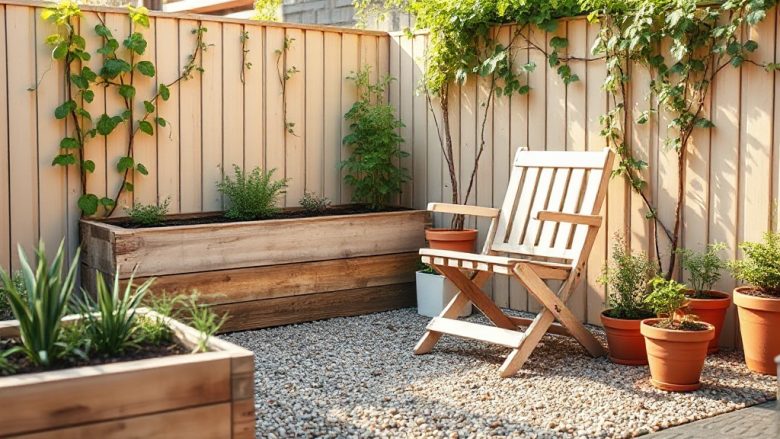
Then go upwards. In a small garden, the walls and fences are free growing space. A simple trellis screwed to a fence gives you room for a climbing rose, jasmine or a productive runner bean. I used an old wooden pallet, taken apart and refixed as a vertical planter, and it now holds strawberries and salad leaves. Old guttering fixed to a wall with brackets makes a brilliant shallow trough for lettuce and herbs. Just drill a few drainage holes first.
Mirrors are the oldest trick in the book for making a small space feel larger, and they still work. A cheap framed mirror hung on a shady fence reflects light and greenery and creates the illusion of another garden beyond. Make sure it’s securely fixed, because wind will find it. A light-coloured fence paint does a similar job for less effort, bouncing light around a dark corner.
3. Planting on a Budget Without Looking Cheap
Plants are where I nearly overspent. Garden centre prices add up fast, and a trolley of mature shrubs can cost more than the paving. The trick is to buy small, buy at the right time, and grow from seed where it makes sense.
Bare-root plants ordered in autumn are a fraction of the price of potted ones and establish better. I bought three bare-root shrubs for the price of one potted plant. They looked like sticks for a season, then filled out. If you’re impatient, spend your money on one or two structural plants that will anchor the design, and fill the rest with cheap annuals and self-seeders.
Seed packets are the cheapest way to fill a small garden with colour. Calendula, nasturtium, nigella and cornflower all germinate easily, and nasturtium flowers and leaves are edible. Sow them directly in gaps in spring and let them sprawl. They’ll cover bare ground while slower plants get going.
Repeat planting is the other free design trick. Using the same three or four plants in different spots makes a small garden look intentional rather than cluttered. I used one type of grass, one dark-leaved shrub and one white flower through the whole plot, and it reads as a scheme rather than a jumble.
Don’t forget the local swap. Neighbours dividing perennials, allotment holders with spare seedlings, and community plant sales are goldmines. I got a carrier bag of hardy geranium cuttings for nothing, and they’ve spread happily ever since.
4. Weekend DIY Projects Using Reclaimed Materials
This is the fun part, and it’s where a small garden starts to feel designed rather than just filled. None of these took more than a few hours.
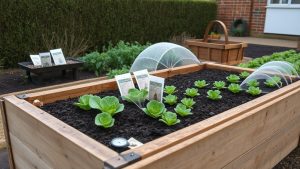
The first project was a raised bed from old scaffold boards. Scaffolding firms often sell used boards cheaply, and they’re sturdy and already weathered. I lined the inside with an old compost bag to slow rotting, filled it with a mix of topsoil and homemade compost, and planted it with salad and herbs. Total cost was a few pounds for fixings.
The second was a seating area made from two pallets. One became a low bench, the other a small table. I sanded them lightly, gave them a coat of fence paint, and added a couple of cheap cushions. It’s not furniture you’d pass down to your grandchildren, but it’s comfortable and it cost almost nothing.
The third was a vertical herb planter made from an old wooden crate fixed to the wall. It holds six pots and sits right outside the kitchen door, which means I actually use the herbs. Proximity matters more than cleverness in a small garden.
One short list of things worth keeping an eye out for: pallets, scaffold boards, bricks, old guttering, wooden crates, terracotta pots from car boot sales, and gravel or bark chip sold off cheaply at the end of the season. Store them somewhere dry until you need them. A shed corner full of salvaged timber has saved me more than once.
5. Common Pitfalls That Make a Small Garden Feel Smaller
The biggest mistake is trying to fit too much in. A lawn, a patio, a shed, a vegetable patch and a water feature in four square metres will feel cramped and chaotic. Choose two functions and do them well. My garden is a seating area and a growing space. That’s it.
Another pitfall is buying a matching set of everything at once. It looks showroom-like and it eats the budget. Mixing materials, as long as the colours are related, looks better and costs less.
Don’t ignore scale. A giant statue or an oversized pot in a tiny garden looks like a mistake. One large pot with a single dramatic plant works far better than six small pots with six mediocre plants. And avoid dark, heavy fencing in a shady garden, because it swallows what little light you have.
Finally, don’t skip the boring bits. Poor drainage, a wobbly fence post or a leaking gutter will undermine everything else. Fix the structure first, then decorate. It’s less exciting, but it saves money later.
A small garden doesn’t need a big budget. It needs a plan, a bit of patience and a willingness to use what’s already there. Start with one corner this weekend. Measure it, watch the light, and put something in the ground. The rest follows.