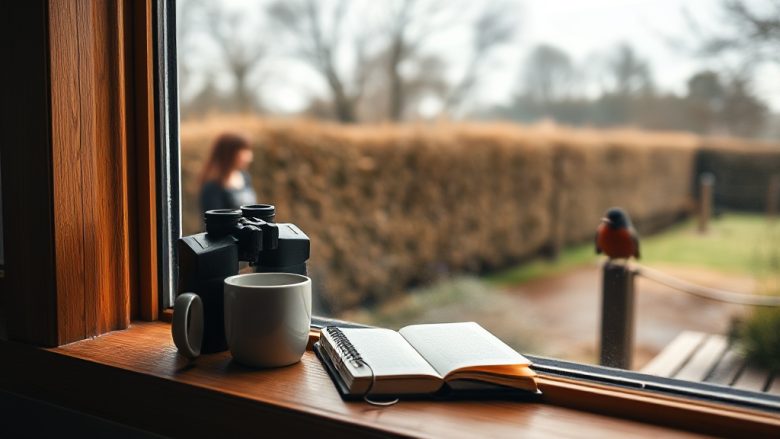
You do not need to travel anywhere. The fastest way into birdwatching is to sit still in one spot near home for twenty minutes and write down what you see. That is it. No reserve, no hide, no expensive gear. A kitchen window, a back step, a bench at the end of the road. Pick one, sit down, and watch. Most people are surprised by how much is already there once they stop moving. This checklist is for the curious adult who has never used binoculars properly and wants a low-pressure way in. It covers the first week, the first month and the first season, plus the frustrations that trip up almost every beginner.
Your First Week: Sit Still and Look
The first week is not about identifying anything. It is about noticing. Choose a single spot within a five-minute walk of your front door. A garden, a park bench, a patch of scrub beside a footpath. Go there at roughly the same time on three or four days and stay for twenty minutes. Same spot, same time, is the whole trick. Birds are creatures of habit, and you will start to recognise individuals and routines faster than you expect.
Take a notebook, or the notes app on your phone. Write down four things for every bird you see: size compared to something familiar, main colours, where it was, and what it was doing. “Sparrow-sized, brown back, grey head, on the fence, hopping” is a perfectly good note. You are building a personal reference file, not a scientific record. Do not try to name things yet. Naming comes later, and it is much easier once you have your own descriptions to match against.
Learn three birds properly this week, not thirty. In most UK gardens and local parks, the ones worth knowing first are the robin, the blue tit and the woodpigeon. They are common, distinctive and easy to tell apart once you have looked at them for a few minutes. A robin has a red breast and a round, upright shape. A blue tit is small, blue and yellow, and rarely still. A woodpigeon is plump and grey with a white patch on the neck. That is enough to start.
Binoculars can wait until the end of the week. The first few days are better without them, because binoculars tempt you to chase birds instead of watching them. Sit still, use your eyes, and let the birds come to you.
Your First Month: Binoculars, Five Calls and a Local Patch
By the end of the first month you should have three things: a pair of binoculars you can actually use, five bird calls you recognise, and a patch you know better than anyone else.
Binoculars are where beginners lose the most money and the most enthusiasm. The specification that matters is the two numbers printed on them, such as 8×42. The first number is magnification, the second is the diameter of the front lens in millimetres. For a beginner, 8×42 is the sensible default. Eight times magnification is enough to see detail without making it impossible to find the bird, and 42mm gathers plenty of light for early mornings and dull afternoons. 10×42 is also fine if you have steady hands. Anything above 10x is harder to hold steady and harder to aim, and anything below 8x will leave you wanting more.
Do not buy the cheapest pair you can find, and do not buy the most expensive either. A mid-range pair from a reputable optical brand will last you years and hold its value if you decide birdwatching is not for you. If you are not ready to spend, borrow a pair from a friend or a local wildlife group for a fortnight first. The important thing is to try before you commit.
Learning to use binoculars is a skill, and it takes a few sessions. The mistake almost everyone makes is trying to find a bird through the binoculars. Do not do that. Keep your eyes on the bird, raise the binoculars to your face without moving your head, and the bird will be roughly in the middle. If you lose it, lower the binoculars, find it with your eyes again, and repeat. It feels clumsy for a week and then it becomes automatic.
Calls are the other half of birdwatching, and they are the part beginners skip. Learn five. The robin’s thin, wistful song is a good first one. The blue tit’s see-see-see is easy to pick out once you know it. The woodpigeon’s five-note coo is unmistakable and often the first call people recognise without help. Add the blackbird’s rich, fluting song and the great tit’s two-note teacher-teacher. Five calls is enough to transform a walk. You will start hearing birds you never noticed before, and half of them will be hidden in hedges where you would never have found them by sight.
Pick a local patch and visit it weekly. A patch is any small area you can get to easily and often. It could be a stretch of canal, a cemetery, a playing field with a line of trees, or a single street of front gardens. The value of a patch is repetition. You learn where the wren hides, which tree the goldfinches favour, and when the first swallows arrive. That accumulated knowledge is what turns watching birds into knowing birds.
Your First Season: Rhythm, Weather and a Few Good Habits
Birdwatching runs on seasons. Spring brings song, summer brings young birds, autumn brings movement, and winter brings flocks. Your first full season will teach you more than any book, because you will see the changes for yourself.
Go out at different times. Early morning is the classic advice and it is good advice, because birds sing most in the first couple of hours after dawn. But late afternoon is also productive, and winter afternoons are often better than winter mornings because the light is softer and the birds are feeding hard before roost. Do not let the idea of a dawn start put you off. A twenty-minute walk after work counts.
Weather matters less than you think. Light rain brings worms to the surface and can be excellent for thrushes and blackbirds. Wind is the enemy, because it keeps small birds low and quiet. A still, grey day is often better than a bright, breezy one.
Keep a simple list. Not a formal year list, just a note of what you saw and when. Over a season it becomes a record of your patch, and it will tell you things you would otherwise forget, like the exact week the first chiffchaff started singing or the day the redwings arrived. A notebook and a pencil are still the best tools for this.
Learn to use your ears more than your eyes. Most birds are heard before they are seen, and a surprising number are never seen at all. Standing still and listening for two minutes will often produce more than an hour of walking and scanning.
Ethics, Disturbance and the Frustrations That Trip Up Beginners
Birdwatching is a low-impact hobby, but it is not zero-impact, and beginners should know the basics from the start. The rule is simple: the bird’s needs come before your view. If a bird changes behaviour because of you, you are too close. That means backing off if a parent bird starts alarm-calling, if a bird stops feeding to watch you, or if you have flushed something from a nest or a roost. During the breeding season, from roughly March to August, this matters most. Keep well back from nests, do not play recordings of birdsong to lure birds in, and keep dogs on leads around grassland and hedgerows where ground-nesting birds may be hidden.
Do not feed birds in a way that creates problems. A garden feeder is fine and genuinely helps, but keep it clean, avoid stale or mouldy food, and do not put out bread. If you are out and about, leave no food behind. Disturbance is cumulative, and a popular site can absorb a lot of quiet watching but not a lot of chasing.
Now the frustrations. Almost every beginner hits the same few walls, and they are all normal.
The first is that everything looks like a sparrow. This passes. It passes faster if you focus on shape and behaviour rather than colour. A bird hopping on the ground with a bobbing tail is a wagtail. A bird clinging to a tree trunk and moving upwards is a nuthatch or a treecreeper. A bird hovering over a field is a kestrel. Behaviour narrows the options before you even see the colours.
The second is that you cannot find anything through binoculars. This is a technique problem, not a gear problem. Practise on a stationary object, like a sign or a leaf, until raising the binoculars becomes automatic. It will.
The third is that you feel you are not seeing anything interesting. You are. Common birds are interesting. The robin you have seen a hundred times is doing something you have never noticed, and noticing it is the whole point. Rarity is not the goal. Attention is.
The fourth is that you feel you should know more. You should not. Nobody starts knowing. The people who seem expert have simply been looking for longer. Give it a season, keep your notes, and the birds will teach you the rest.